


Welcome to our research project dedicated to revolutionizing
orchid plant health
management through the integration of advanced technologies.
About Us
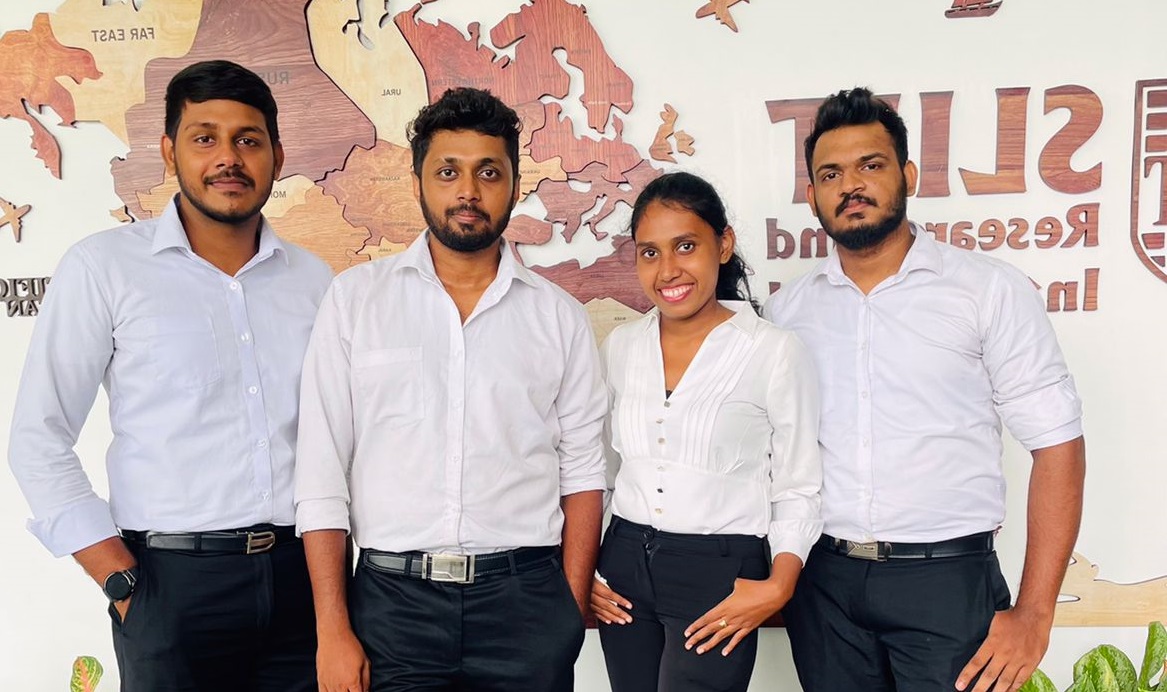
Our research team comprises experts in the fields of computer science, plant pathology, and agricultural technology. We are passionate about leveraging technology to solve real-world problems and are dedicated to making a positive impact on the orchid cultivation industry.
We believe in the power of user collaboration. By incorporating user input and feedback, our system not only improves its diagnostic capabilities but also becomes a valuable tool for orchid growers, providing them with personalized recommendations and actionable insights for disease management.
Utilizing the latest advancements in image processing technology, our system captures real-time images of orchid plants using an IoT device equipped with a high-resolution camera module.
Our system integrates IoT devices for real-time image capture, allowing for constant monitoring of orchid plants. This real-time data collection is crucial for timely disease detection and intervention.
The project involves developing a sophisticated system for the identification, diagnosis, and monitoring of diseases in orchid plants, leveraging cutting-edge image processing and deep learning technologies. This system aims to automate the detection of unhealthy plants, accurately diagnose specific diseases, monitor disease progression, and continuously improve the identification model through user input. The system integrates an IoT device with a camera module for real-time image capture, a web application for data processing, and cloud storage solutions for efficient data management. By employing RCNN and CNN models for health and disease detection, respectively, and advanced image processing techniques for monitoring, the system provides actionable insights and recommendations for disease management. This project seeks to enhance plant health monitoring, streamline disease identification processes, and expand the capability of disease detection models, ultimately contributing to the sustainability and productivity of orchid cultivation.
Objective: Revolutionize orchid cultivation with an IoT-driven system that automates daily plant health assessments through advanced image capture and processing. Details: Develop and deploy IoT devices equipped with high-resolution cameras to capture and transmit orchid plant images to an AWS S3 cloud. This system will establish a seamless, real-time monitoring framework, reducing human intervention and ensuring continuous data collection essential for precise health analysis.
Objective: Spearhead the application of state-of-the-art RCNN models to differentiate between healthy and diseased orchid plants with unprecedented accuracy and speed. Details: Train an advanced deep-learning model using a meticulously curated dataset, featuring diverse instances of orchid health conditions. The model will swiftly identify and categorize unhealthy plants, storing pertinent images in a MongoDB database for further investigation and intervention.
Objective: Develop a sophisticated CNN-based disease identification model capable of discerning specific orchid diseases, such as black rot and black dot disease, with expert-level precision. Details: Harness the potential of deep neural networks to meticulously analyze images extracted from the MongoDB database. By accurately diagnosing diseases and providing actionable insights, this model will facilitate prompt and targeted treatment strategies, ensuring optimal orchid health and yield.
Objective: Pioneer advanced image processing methodologies to quantitatively assess disease progression and its impact on orchid plants over time. Details: Implement a comprehensive workflow encompassing HSV colour space conversion, histogram equalization for contrast enhancement, and shadow removal. By creating precise colour masks and quantifying disease-affected areas, this system will enable dynamic monitoring and proactive management of orchid health, supported by intuitive visualizations using Matplotlib.
Objective: Establish a dynamic ecosystem for continual model refinement and expansion of disease detection capabilities, ensuring responsiveness to emerging orchid health challenges. Details: Integrate a user-centric approach for uploading and validating new disease images via Google Drive. Upon verification and accumulation of sufficient data, such as 1000 images per newly identified disease, the system will autonomously update and enhance its diagnostic prowess through iterative retraining cycles. This iterative process guarantees the system's resilience and readiness to identify and combat evolving orchid diseases effectively.
The proposed system presents an innovative IoT-based solution tailored specifically for orchid farmers and stakeholders, revolutionizing disease detection and management in orchid plants. By harnessing the power of IoT technology, this system aims to empower farmers with timely information to mitigate disease outbreaks and optimize orchid health. Furthermore, it serves as a valuable tool for agricultural researchers, facilitating the dissemination of crucial information regarding newly identified diseases to farmers, thereby enhancing overall orchid cultivation practices.
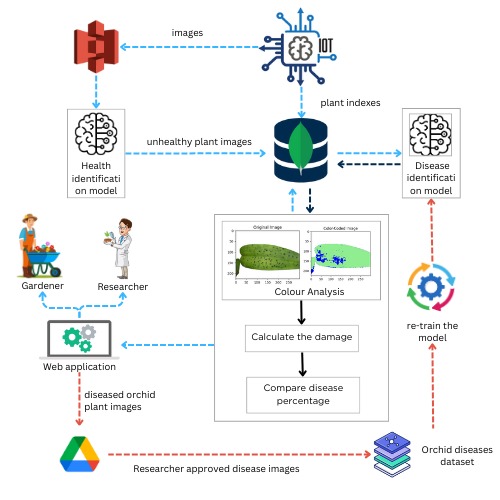
As shown in Fig. 1, the system starts its operation when farmers activate the IoT device through a web application interface. Once activated, the device captures comprehensive images of the entire orchid nursery, which are then seamlessly uploaded to a designated cloud server for processing and storage. These images are subsequently processed by sophisticated Convolutional Neural Network (CNN) models hosted on a Flask server. If any anomalies indicative of plant diseases are detected, the corresponding images are archived in MongoDB.
Upon detection of a potentially diseased plant, another CNN model is employed to accurately identify the specific disease afflicting the plant, updating the relevant MongoDB document with the disease name. Furthermore, the system employs colour analysis techniques to quantify the extent of the affected area in the diseased plant image. This analysis involves comparing the current diseased area percentage (CP) with the previously identified diseased plant (PP). If CP exceeds PP, indicating a worsening condition, an automated warning message is promptly dispatched to the user, alerting them to take necessary actions.
In essence, this IoT-based smart system represents a groundbreaking approach to disease detection and management in orchid cultivation. By leveraging cutting-edge technology, it not only empowers farmers with early disease identification capabilities but also facilitates seamless communication between farmers and agricultural researchers, fostering a collaborative environment for continuous improvement in orchid farming practices.












A Project Proposal is presented to potential sponsors or clients to receive funding or get your project approved.
Progress Presentation I reviews the 50% completetion status of the project. This reveals any gaps or inconsistencies in the design/requirements.
Describes what you contribute to existing knowledge, giving due recognition to all work that you referred in making new knowledge
Progress Presentation II reviews the 90% completetion status demonstration of the project. Along with a Poster presesntation which describes the project as a whole.
The Website helps to promote our research project and reveals all details related to the project.
Status of the project is validated through the Logbook. This also includes, Status documents 1 & 2.
Final Report evalutes the completed project done throughout the year. Marks mentioned below includes marks for Individual & group reports and also Final report.
Viva is held individually to assess each members contribution to the project.
This research documents explores how climate change affects
coastal ecosystems, focusing on rising sea levels,
increased
temperatures, and ocean acidification. It examines the
consequences for biodiversity, habitat loss,
and the livelihoods
of communities dependent on these environments, proposing
mitigation
and adaptation strategies.
This research documents explores how climate change affects
coastal ecosystems, focusing on rising sea levels,
increased temperatures, and ocean acidification. It
examines the consequences for biodiversity, habitat loss,
and the livelihoods of communities dependent on these
environments, proposing mitigation
and
adaptation strategies.

Department of Computer Science and Software Engineering Faculty of Computing Sri Lanka Institute of Information Technology New Kandy Road, Malabe, Sri Lanka

Department of Computer Science and Software Engineering Faculty of Computing Sri Lanka Institute of Information Technology New Kandy Road, Malabe, Sri Lanka
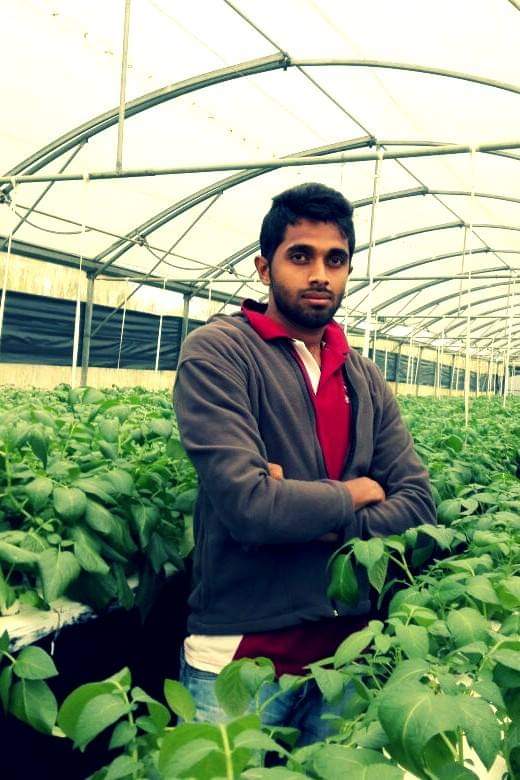
Hansagiri Group 586, Galle Road, Beruwala

Department of Computer Science and Software Engineering Faculty of Computing Sri Lanka Institute of Information Technology New Kandy Road, Malabe, Sri Lanka

Department of Computer Science and Software Engineering Faculty of Computing Sri Lanka Institute of Information Technology New Kandy Road, Malabe, Sri Lanka

Department of Computer Science and Software Engineering Faculty of Computing Sri Lanka Institute of Information Technology New Kandy Road, Malabe, Sri Lanka

Department of Computer Science and Software Engineering Faculty of Computing Sri Lanka Institute of Information Technology New Kandy Road, Malabe, Sri Lanka